Posted by
Bear Safety Team
on
July 16, 2026
Forklifts, pedestrians and delivery vehicles often share the same working environment around loading bays, production and storage areas. In a busy warehouse or manufacturing site, that can create daily risk — especially where walkways cross vehicle routes, visibility is poor, or people become used to the same warning signs over time.
For operations managers and health and safety teams, the goal is not simply to add more signs. The real goal is to create a safer, clearer and more controlled workplace where people understand where they should walk, where vehicles are moving, and when extra caution is needed.
This is where forklift and pedestrian safety planning becomes essential.
Forklift trucks are essential in many industrial environments, but they also create serious risk when they operate close to pedestrians. Risk can increase around:
In many cases, the problem is not that people are unaware of the risk. It is that the working environment becomes busy, repetitive and familiar. Pedestrians may take shortcuts. Drivers may have limited visibility. Painted markings may fade. Static signs may become part of the background.
Over time, safety messages can lose impact.
That is why good forklift and pedestrian safety needs to combine planning, visibility, communication and behaviour.
The first step is always to look at whether pedestrians and vehicles can be separated. This could include dedicated pedestrian routes, physical barriers, one-way vehicle systems, separate doorways, controlled crossing points and clear loading bay procedures.
Where separation is possible, it should usually be prioritised. A clearly defined pedestrian route is easier to manage than a shared area where everyone is expected to “just be careful”.
However, full separation is not always practical. Many warehouses and manufacturing sites have space constraints, changing layouts, production demands or existing building limitations. In these situations, the next priority is to make shared areas as clear and controlled as possible.
Where pedestrians and forklifts need to cross paths, the crossing point should be easy to recognise and understand.
A good crossing point should answer three questions quickly:
Where should pedestrians cross?
Where should drivers expect pedestrians?
Who has priority in that moment?
Traditional painted crossings and floor markings can work well in some environments. But in busy industrial areas, markings can become worn, dirty, covered by pallets or harder to see under changing light conditions.
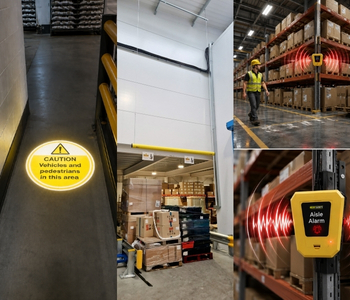
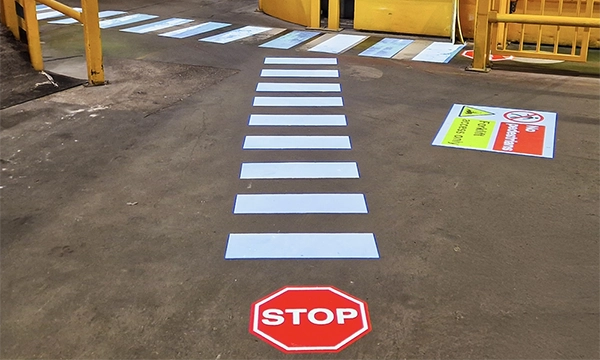
Projected safety markings can help by creating bright, visible walkways, zebra crossings, STOP signs or warning symbols on the floor or wall. Unlike paint, projected markings do not wear away from forklift traffic, cleaning, dust or tyre marks. They can also be relocated or adjusted if the site layout changes.
Not every warning needs to be visible all the time. In fact, too many permanent signs can become visual noise.
Dynamic safety systems can help by displaying warnings only when they are relevant. For example, a projected “No Pedestrians” sign can activate when a forklift enters a VNA aisle. A doorway alert can project a warning when there is vehicle movement nearby. A crossing system can help make priority clearer at key interaction points.
This matters because people are more likely to notice a warning when it appears at the right time, in the right place, and in response to a real hazard.
Instead of relying only on memory or static signs, dynamic visual safety supports the decision-making moment.
Doorways, aisle ends and blind corners are common risk points. Pedestrians may step into an area without seeing an approaching vehicle. Forklift drivers may have restricted visibility, especially when carrying loads.
Consider whether your site needs:
The right solution depends on the site. A doorway between a staff area and a forklift route may need a different approach from a warehouse aisle or loading bay crossing.
This is why a site-specific review is often more useful than choosing a product first.
A common concern for operations teams is that safety improvements might slow the site down. But good safety design should support operational flow, not fight against it.
Clear routes help pedestrians move confidently. Clear crossing points help drivers anticipate where people may appear. Automated warnings can reduce confusion and improve awareness without relying on someone to manually switch signs on and off.
The best systems are easy to understand at a glance.
For example, a projected red warning, a bright pedestrian crossing or a clear “STOP” symbol can be understood quickly by visitors, contractors, drivers and employees. That helps create consistency across the site.
Many sites already have safety signs, painted walkways and floor markings in place. The question is whether they are still working effectively.
So often they:
Are worn or faded
Are hidden behind stock or equipment
Compete with too many other signs
Are placed too far from the actual hazard
Do not reflect the current site layout
Are ignored because people see them every day
Do not give enough warning at the decision point
If a sign is still necessary, it should be clear, visible and relevant. If it no longer helps reduce risk, the site may need a better approach.
Employees may understand your site layout because they work there every day. Visitors, contractors and temporary staff may not.
This is especially important in yards, loading areas, warehouses and production sites where vehicle movement is frequent. Clear visual safety cues help people understand the expected route without needing detailed knowledge of the building.
A visible projected walkway, doorway warning or crossing point can make the safe route easier to follow.
Projected safety lighting can be especially useful where:
It is not about replacing every sign on site. It is about using the right visual safety solution in the right location.
If you are reviewing forklift and pedestrian safety, start by mapping the areas where people and vehicles interact. Look at crossings, doorways, blind corners, loading areas, VNA aisles and routes where pedestrians walk close to moving vehicles.
Then ask:
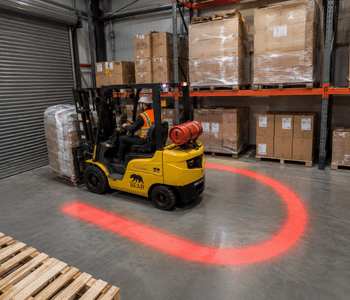
Bear Safety provides site-specific safety solutions including projected walkways, automated crossings, doorway alerts, aisle alarms, warning bars and forklift safety systems. Our team can review your site layout, risk areas and operational needs to recommend a practical solution.
Need help improving forklift and pedestrian safety on your site? Request a Bear Safety site review and we’ll help identify the right starting point.

Proactive Safety Solutions for reducing risk in industrial environments