Posted by
Bear Safety Team
on
September 4, 2026
Vehicle warning systems can improve awareness where pedestrians and mobile equipment operate close together. Choosing the right alert requires more than selecting the brightest light or loudest alarm. It begins with the specific risk and the action people need to take.
Busy industrial sites rarely have one type of traffic risk. A warehouse may contain forklifts, pallet trucks, delivery vehicles, contractors and pedestrians, all moving through spaces designed around production and storage. Noise, racking, doors and changing stock levels can further reduce the time available to recognise an approaching vehicle.
Vehicle warning systems add information to that environment. They can help a driver recognise an obstruction, alert a pedestrian to vehicle movement or make a danger zone more visible. However, the same warning will not suit every location. The most effective choice is based on a site-specific risk assessment and forms part of a wider system that includes safe routes, segregation, training and supervision.
A vehicle warning system is any device or combination of devices used to communicate the presence, movement or proximity of a vehicle. Some systems are fitted directly to the vehicle. Others are installed at a fixed location, such as a doorway or aisle intersection. A system may operate continuously, activate when movement is detected or respond only when two users approach a defined conflict point.
The warning can be audible, visual or both. It may alert the driver, the pedestrian or everyone in the area. Before choosing a product, define who needs the information, when they need it and what you expect them to do next.
Horns, reversing alarms and fixed audible alerts can attract attention when a vehicle is moving or approaching. They are familiar and can work in areas where a person is not facing the hazard. The warning must be distinct enough to be recognised above ambient sound without creating unnecessary noise. HSE guidance notes that alarms may become difficult to locate or blend into the background on a busy site.
Consider who may have difficulty hearing the alarm, how often it will sound and whether other machinery produces a similar tone. In some locations, an audible warning is strongest when paired with a clear visual signal.
Flashing or rotating lights can show that a vehicle, door or crossing is active. They are useful in noisy environments and can provide a consistent site-wide visual language. Position matters: the light must be within the user's normal field of view and should not be hidden by racking, stored goods or structural columns.
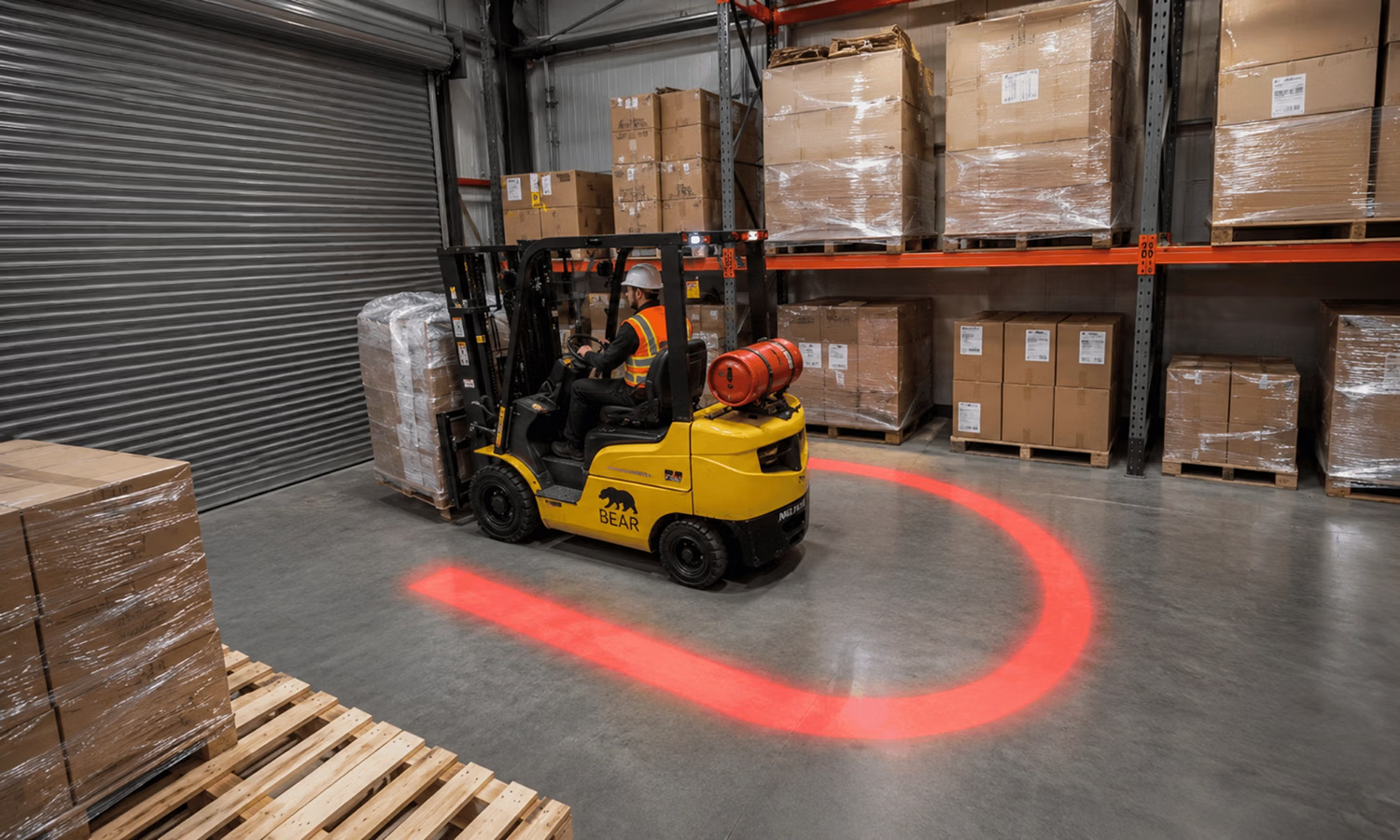
Forklift-mounted lights can project a coloured line, spot or boundary onto the floor around the vehicle. A halo-style system helps pedestrians judge a defined separation zone without needing to estimate distance from the truck. This can support awareness in shared areas, but the projected zone must be set for the actual mounting height, travel direction and operating environment.
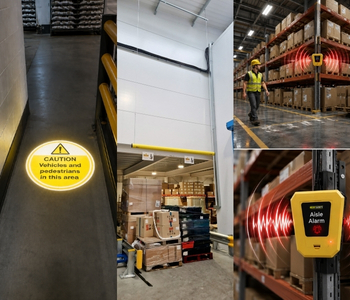
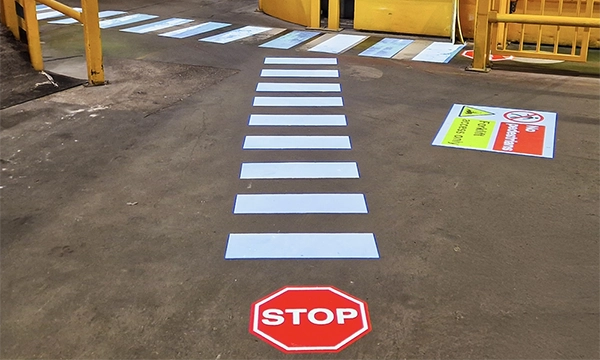
Industrial projectors can place a symbol, message, walkway or crossing directly in the area where a decision is required. Unlike paint or adhesive markings, a projected image is not worn away by tyres and can remain visible on some rough or dusty surfaces. It can operate continuously or be triggered by a sensor.
Projected warnings are particularly useful where a wall-mounted sign is outside the line of sight or where the site wants the message to appear only when a hazard is present. The design should remain simple, recognisable and large enough for the available viewing distance.
Detection can turn a passive warning into an event-based alert. At a blind aisle intersection, sensors can detect movement from one or both directions and activate an LED, audible alarm or projected symbol. At a doorway, a warning may activate when a vehicle is approaching the pedestrian exit. The detection range and timing should give users enough notice without triggering so often that the alert loses meaning.
Mirrors, cameras, radar and proximity sensors can help drivers identify people or objects that are difficult to see. Some devices warn the operator; others can be integrated into a broader control system. The right choice depends on vehicle type, speed, stopping distance, detection reliability and the complexity of the operating area.
Start at the conflict point and work outwards. Observe the route in use and ask practical questions before comparing products:
A site survey should include views from both sides of the interaction. A warning that is obvious from a supervisor's standing position may be hidden from a seated forklift operator or a pedestrian emerging through a door.
Warnings lose value when they activate constantly or when too many devices compete for attention. If every forklift movement triggers the same light and alarm across a large area, people may stop connecting it with a specific action. This is sometimes described as alarm or warning fatigue.
Use the most targeted message possible. Define a detection zone around the actual conflict, select a signal that differs from routine background activity and remove redundant warnings. Brief users on what each alert means. Event-based systems are helpful when they make the warning relevant to a genuine movement rather than adding continuous visual noise.
Technology should not be used to justify an avoidable shared route. First consider whether vehicles and pedestrians can be separated, whether the route can be changed or whether reversing can be reduced. Then select warnings for the residual risk that remains. This creates a more dependable arrangement than relying on one device to compensate for a weak layout.
Once installed, test the system during normal operations. Check the warning from relevant approach distances, confirm users understand the expected response and record routine inspections. Review settings if the layout, vehicle fleet, lighting or workflow changes.
A good vehicle warning system gives the right person clear information at the right moment. It does not need to be complicated. The best solution may be a simple visual alert at one doorway, or it may combine detection, control and projected warnings across a busy crossing. The decision should follow the risk, not the technology.
Bear Safety supplies projected signs, automated crossings, doorway alerts, aisle alarms and forklift-mounted visual warning systems. Request a site survey to identify which options are suitable for your traffic routes and operating conditions.
Proactive Safety Solutions for reducing risk in industrial environments.

Proactive Safety Solutions for reducing risk in industrial environments