Posted by
Bear Safety Team
on
July 29, 2026
Painted floor markings have been used in warehouses, factories and logistics sites for years. They help show pedestrian routes, crossings, exclusion zones, forklift areas and loading bay boundaries.
However, in many industrial environments, painted markings do not stay clear for long.
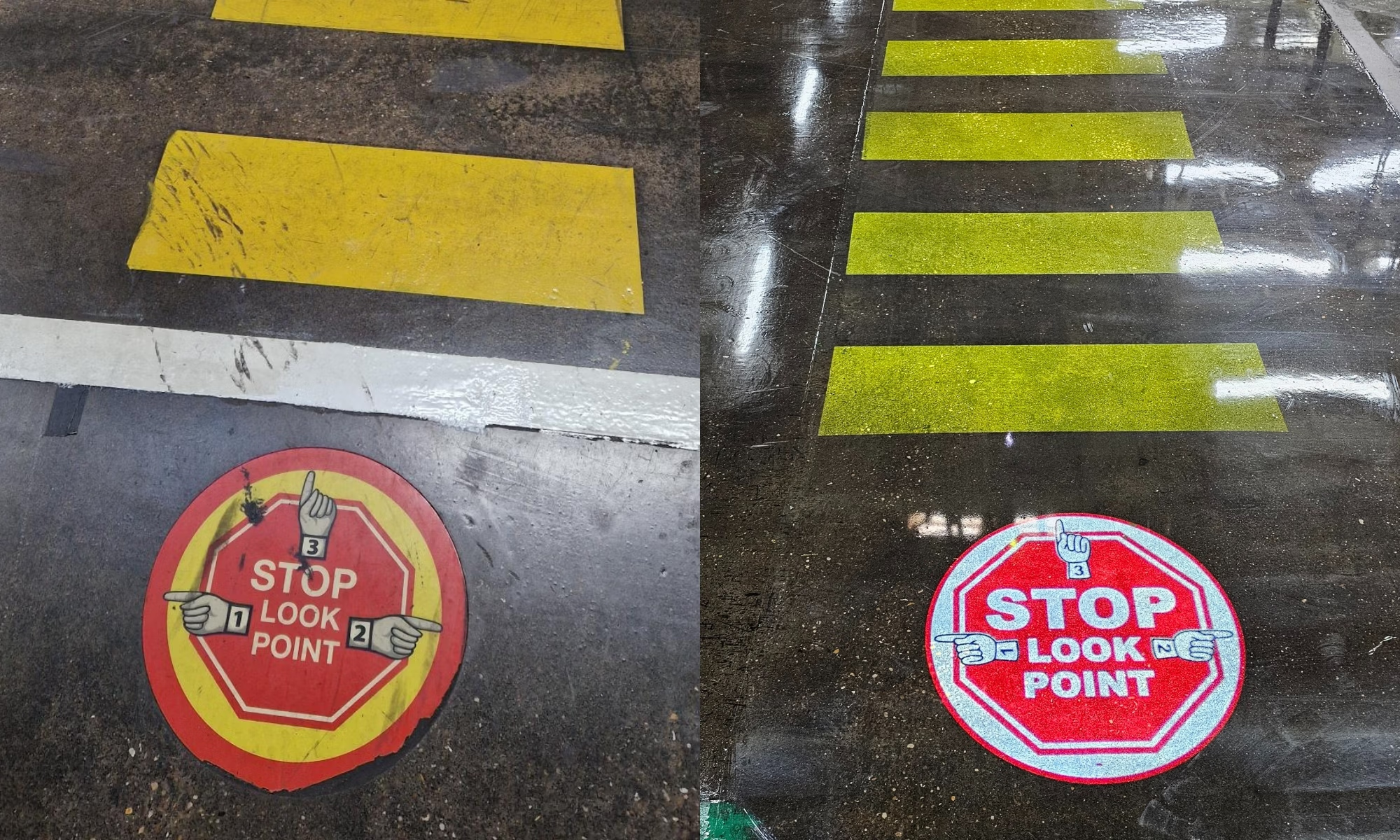
Forklift traffic, cleaning, dust, pallets, wet conditions and general wear can make painted lines harder to see. When markings fade, the safety message becomes weaker. When the site layout changes, repainting can also create downtime and additional maintenance costs.
That is why more operations and health and safety teams are considering projected safety signs and projected floor markings as an alternative.
Both options have a place. The right choice depends on your site, its hazards and how frequently the working environment changes.
Painted floor markings are physical markings applied directly to the floor. They are commonly used for:
Paint can be effective in clean, stable pedestrian environments where the floor is in good condition and traffic levels are manageable. It is familiar, easy to understand and suitable for many standard layouts.
However, painted markings rely on the surface remaining visible and intact. In high-traffic industrial areas, that can be difficult.
Painted markings can become less effective when they are:
The issue is not just appearance. If people stop noticing a marking, or if it becomes unclear, the safety message may not work as intended.
For busy operations, repainting can also mean planning downtime, clearing the area, waiting for the paint to dry or cure, and repeating the process when the marking wears away again.
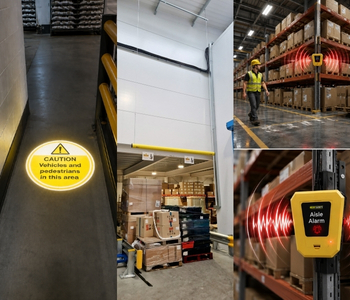
Projected safety signs use industrial projectors to display signs, symbols, walkways or markings onto a floor, wall or other surface. This can include:
Because the marking is projected rather than painted, it does not wear away when forklifts drive over it. It can also remain visible on surfaces where paint or tape may be difficult to maintain.
Projected safety signs are particularly useful in areas where the risk is specific, repeated or difficult to manage with static signage alone.
Safety signs and markings need to be clear, legible and easy to understand. If they are faded, hidden or surrounded by too many other visual messages, they may not support safer behaviour effectively.
This is where projected safety lighting can add value. A bright projected sign can stand out in busy environments and reinforce a message where people need to see it.
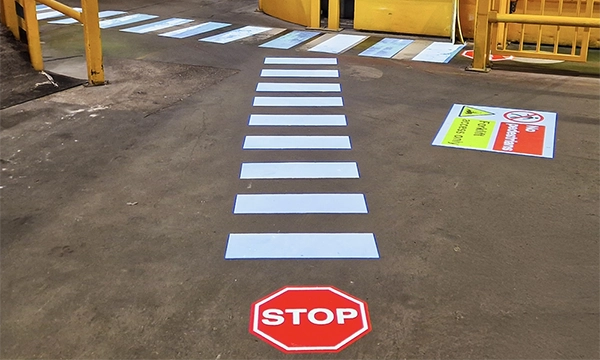
For example, a projected crossing on a warehouse floor can make a pedestrian route more visible. A projected warning at a doorway can alert people before they enter a vehicle route. A projected STOP symbol can support traffic control at a key decision point.
The message becomes part of the working environment without requiring the floor to be repainted.
One of the main differences between painted markings and projected safety signs is that projected signs can be dynamic.
A painted crossing is always present. That may be suitable for a permanent pedestrian route.
However, some risks are not constant. A warning may only be needed when a forklift is approaching, when a door opens, when a vehicle enters an aisle or when a particular hazard is active.
In these situations, automated projected warnings can be more relevant than a permanent sign. A warning that appears at the appropriate moment may be more noticeable than one that is always present.
This can help address sign blindness, where people become so familiar with seeing the same message that they stop actively noticing it.
Painted floor markings can still be suitable where:
For simple, stable environments, paint may be sufficient.
Projected safety signs may be more suitable where:
Projected signs can also be helpful in environments where hygiene requirements, regular cleaning, cold temperatures or difficult surface conditions make traditional markings harder to maintain.
Paint may appear less expensive initially, but it can require ongoing maintenance. If markings need to be refreshed frequently, the total cost can include labour, materials, downtime and disruption.
Projected signs require an upfront investment, but they remove the issue of floor marking wear. They can also be adjusted, moved or automated depending on the application.
For operations teams, the question is not only, “Which option is cheaper today?” A more useful question is:
Which option will remain clear, visible and effective over time?
The answer may vary across different parts of the same site. Some areas may only need paint, while others may benefit from a projected safety solution.
Imagine a warehouse crossing where pedestrians move between a production area and a picking area. Forklifts regularly pass through the same route.
If the crossing is painted, it may become worn by forklift traffic. If pallets are temporarily placed nearby, the route may also become less obvious. Drivers and pedestrians may begin to rely on habit rather than a strong visual cue.
A projected crossing can make the pedestrian route more visible. If sensors are added, the system can also support an automated warning when vehicle movement is detected.
The result is not simply a brighter crossing. It creates a clearer communication point between pedestrians and drivers.
The most appropriate safety solution depends on the site. A painted walkway, projected walkway, automated crossing, doorway alert, warning bar or aisle alarm may all be suitable in different situations.
Before choosing a solution, review:
This helps ensure that the selected solution supports both site safety and day-to-day operations.
Bear Safety provides site-specific projected safety lighting and automated industrial safety solutions for warehouses, manufacturing sites, logistics facilities and other industrial environments.
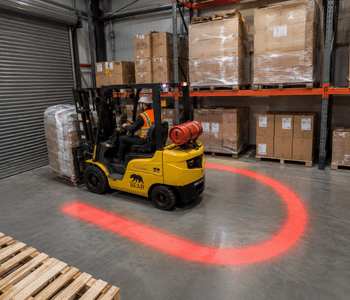
Our solutions include projected walkways, projected crossings, projected signs, automated warnings, doorway alerts, aisle alarms, warning bars, forklift halo systems and other visual safety solutions.
These systems can help improve visibility, reduce reliance on worn floor markings and support clearer communication between pedestrians and vehicles.
Not sure whether painted markings or projected safety signs are right for your site? Request a Bear Safety site review and we’ll recommend the most practical option for your environment.
Proactive Safety Solutions for reducing risk in industrial environments.

Proactive Safety Solutions for reducing risk in industrial environments